Pillows & Ergonomic Comfort
Buckwheat and Wool: What Pillow Fill Means for Upright Support
A pillow can turn a quick reading break into a comfortable stretch of the afternoon—or leave you shifting, stacking, and searching for a better angle. When you’re sitting up or reclining, the fill inside matters. Buckwheat hulls bring a firmer, adjustable feel; wool adds a softer layer of cushioning. Together, they show how different materials can shape support, airflow, and everyday comfort.
Pillows are often discussed as if their only job happens at bedtime. In real homes, they do plenty of other work: propping someone up with a book, cushioning the back during a favorite show, or making a supported position on an adjustable bed feel a little more inviting. These moments ask something different of a pillow than a full night’s sleep. It needs to stay where you put it, feel comfortable against the body, and offer support without turning a relaxed posture into a stiff one.
That is where pillow materials enter the conversation. A fill’s structure can influence how a pillow settles, whether it can be reshaped, how firm it feels, and how easily air moves through it. Buckwheat hulls and wool offer a useful contrast. Hulls create a substantial, shape-holding foundation; wool can contribute softer cushioning. Neither material is automatically best for everyone, and neither promises a particular health outcome. But understanding what each is likely to feel like can make it easier to assess whether a pillow suits your own reading or lounging routine.
First, what does “upright support” mean?
Upright support is not one fixed position. It can mean sitting nearly vertical against a headboard, reclining with the upper body raised, or leaning back into a sofa with a cushion behind the shoulders. A pillow used this way may support several areas at once: the lower or upper back, the shoulders, the neck, or even an arm resting across it. The experience depends not just on fill, but on the pillow’s size, shape, cover, and the furniture beneath it.
A pillow that feels pleasantly plush when you first lean back may compress under sustained pressure. A firmer one may keep its shape but feel too solid against the body. The most useful question is not simply, “Is it soft or firm?” Instead, consider whether it holds a comfortable position for the way you actually sit, and whether you can adjust it when that position changes.
The surface beneath the pillow matters, too. A deep sofa, a structured chair, and an adjustable bed all create different angles and pressure points. Someone reading upright may want a cushion that supports the back without pushing the head forward. Someone reclining may need a different arrangement, perhaps placing a pillow behind the shoulders or alongside the body. There is no single pillow setup that works for every chair, bed, or body.
Buckwheat hulls: a firm, movable foundation
Buckwheat hulls are the outer shells of buckwheat seeds. In a pillow, they behave less like a fluffy mass and more like a collection of small, distinct pieces. That gives the fill a characteristic feel: firm, substantial, and capable of shifting as the pillow is moved. Rather than simply springing back like some lofty fills, hulls can settle into a shape and offer a degree of resistance beneath the body.
That shape-shifting quality is one reason buckwheat pillows appeal to people who like to fine-tune their support. A user can redistribute the fill by pressing or shaking the pillow, and some designs allow more or less material to be removed. In an upright position, a moldable core may be arranged to support a particular area, though how well it works depends on the pillow’s dimensions and the demands of the seat.
The trade-off is that firm, movable fill is not the same thing as plush cushioning. Buckwheat hulls can feel dense and textured, and the shifting pieces may make a soft, rustling sound as the pillow moves. Some people appreciate the stable, adjustable character; others prefer a smoother, quieter, more yielding surface. Personal preference is central, especially if the pillow will be used against the back or shoulders for long periods.
Buckwheat’s structure can also leave spaces between the hulls. Those gaps may allow air to move through the fill more readily than through a tightly packed, solid material. Still, how cool a pillow feels depends on the complete design: the amount of fill, its construction, the cover fabric, room temperature, and how much of the pillow is in contact with the body. “Breathable” should not be read as a guarantee that a pillow will feel cool in every setting.
Wool: soft cushioning with structure of its own
Wool brings a different character. Instead of a bed of individual hulls, it creates a layer of fibrous cushioning. Its feel can be softer and more yielding, and it may help ease the transition between a firm core and the body. Wool is not necessarily feather-soft or weightless; depending on how it is prepared and used, it can have resilience and a gently supportive feel. The important distinction is that wool generally cushions in a more continuous way than loose buckwheat hulls.
In a pillow designed for sitting or reclining, a softer layer can make a firm center feel more approachable. It may provide a more comfortable contact surface for the back or head while the firmer portion helps the pillow retain shape. This combination is particularly interesting for people who want support but do not want every part of the pillow to feel equally firm.
Wool is also associated with natural temperature and moisture management, but those properties should be understood in context. The finished pillow’s comfort depends on its construction, cover, thickness, and surrounding environment. A wool layer does not make every pillow cool, nor does it eliminate the possibility of feeling warm. When evaluating materials, look at the complete assembly rather than assuming that one fiber determines the whole experience.
Why combine the two?
A dual-chamber pillow offers a simple but helpful design lesson: materials with different qualities can work together rather than compete. One chamber can hold a firmer, adjustable fill, while another provides a softer comfort layer. The result is not merely a midpoint between firm and soft. It is a pillow with distinct components, each contributing something different to how it feels.
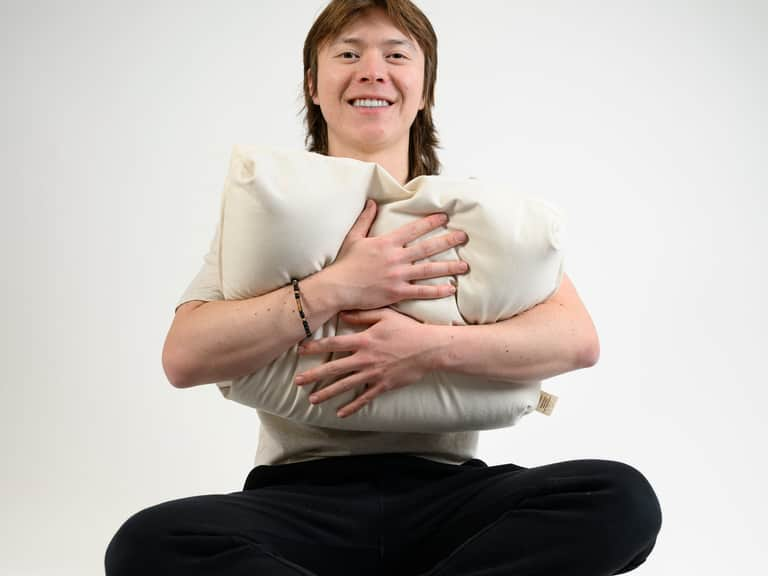
The Rejuvenation Pillow is a practical example of this approach. It pairs a buckwheat-hull foundation with a natural wool comfort layer in a cotton sateen cover. Its dual-chamber construction keeps the materials separate, and a zipper in the buckwheat-hull chamber allows the loft and firmness to be adjusted by changing the amount of hull fill. The pillow is designed for side and back sleepers, but its construction also makes it a useful reference when thinking about how layered materials can feel during reading or relaxed lounging.
The ability to adjust the hull chamber can be useful because a pillow’s original loft may not suit every user or setup. Removing some fill may create a lower profile or a less dense feel; keeping more may preserve a fuller, firmer foundation. Adjustments should be made gradually, with the pillow tested in the position where it will actually be used. A configuration that feels comfortable while lying down may feel different when the upper body is raised against a headboard.
The wool layer contributes cushioning, while the hull chamber supplies the firmer core. How much each quality stands out will vary with the way the pillow is arranged and the pressure placed on it. A layered pillow is not a substitute for choosing the right size or supporting furniture, but it can offer a broader range of feel than a single-material fill.
Loft, firmness, and shape: the details to check
Loft refers to a pillow’s height or thickness. In upright support, loft influences where the pillow meets the body and how much space it fills between the user and the chair or headboard. A pillow that is too tall for a particular position may push the head or shoulders forward. One that is too flat may fail to fill the gap the user wanted to cushion. The right amount depends on the person, the seat, and the intended posture.
Firmness describes resistance under pressure, though the word is subjective. Two pillows labeled firm can feel very different if one uses loose hulls and another uses a continuous fibrous fill. With a buckwheat pillow, firmness may also change as the hulls are moved or removed. With a wool layer, the surface may feel softer even when the pillow has a firm foundation underneath.
Shape is equally important. A broad, square pillow may support a larger area of the back, while a narrower design may fit more naturally behind the shoulders or neck. A bed pillow used as a backrest may slide or bunch if it is not sized for that purpose. Think about where the pillow will rest, whether it will be supported by furniture, and how much of the body you want it to cover.
- Check the contact points. Notice whether the pillow supports the area you intended without creating uncomfortable pressure elsewhere.
- Try your usual activity. Read, use a device, or relax in the position you expect to use most often rather than judging the pillow only by touch.
- Test small adjustments. If the fill is adjustable, make gradual changes and give each arrangement a fair trial.
- Consider the whole setup. Chair depth, headboard angle, mattress movement, and nearby cushions can all affect how stable the pillow feels.
Using a pillow while reading or lounging
A comfortable reading position is often a matter of several small choices rather than one perfect pillow. Begin with a seat or bed angle that feels relaxed, then place the pillow where it fills a gap without forcing the body into a rigid position. If your shoulders feel crowded or your head is being nudged forward, the pillow may be too high, too full, or positioned in the wrong place. If it slips away or collapses quickly, the size, fill, or supporting surface may not be working for that use.
When using an adjustable bed, raising the head section changes the relationship between the body and any loose pillow placed behind it. A pillow may shift as the bed moves, so it can help to reposition it after changing the angle. Some people prefer a pillow behind the upper back; others find it more comfortable to support a smaller area. Experiment carefully, and avoid assuming that a preset “zero-gravity” position automatically makes a particular pillow arrangement suitable for everyone.
For a chair, consider whether the backrest already offers substantial contouring. A very full pillow on a deeply cushioned chair may crowd the sitting space, while a firmer, lower-profile cushion may fit more naturally. In a less supportive chair, a pillow may help fill a gap, but it cannot change the chair’s underlying shape or correct a poor fit by itself.
Airflow and everyday comfort
Airflow is a popular topic in pillow materials because warmth can influence whether a person wants to keep using a pillow. The open structure of buckwheat hulls may allow air to circulate within the fill, while wool is valued for its fiber characteristics. But a pillow is a layered object: cover fabric, stitching, chamber design, fill density, and the way it is pressed against the body all play a part.
A thick cover can affect the sensation at the surface. A densely packed chamber may feel different from a loosely filled one. And a pillow pressed between the back and a chair has less exposed surface than one resting freely on a bed. If temperature is a concern, assess the actual pillow in the environment where you plan to use it. Product descriptions can explain materials, but they cannot replicate every person’s experience.
Care routines matter, too. A removable or washable cover can simplify cleaning, but the fill itself may require different handling. Follow the care instructions for the specific pillow rather than assuming that all natural fills can be washed the same way. Keeping the cover clean and allowing materials to dry fully after care helps maintain a pleasant everyday setup.
Who might prefer each feel?
Buckwheat may appeal to someone who likes a firmer, more substantial pillow and values the ability to move or adjust the fill. It can be a good material to explore for people who prefer a pillow that does not feel uniformly fluffy. However, its weight, texture, and rustling sound may be drawbacks for those who want a soft, silent cushion.
Wool may appeal to someone who wants a gentler surface or a cushioning layer alongside a more supportive core. It may also interest people who prefer natural fibers. Yet wool’s feel varies by construction, and a wool layer alone may not provide the shape-holding quality some users seek for upright lounging.
A combination may suit someone who wants both qualities in one design, especially when the firmer chamber can be adjusted. Still, “best” is personal. Body proportions, preferred seating angle, sensitivity to texture, room temperature, and the type of furniture can change the verdict. Whenever possible, use a return or trial policy to evaluate comfort over more than a brief first impression.
A thoughtful way to compare pillow materials
Instead of treating fill as a badge of quality, think of it as a set of practical characteristics. Does the pillow hold its shape? Can it be adjusted? Does it feel smooth or textured? Is the surface comfortably cushioned? Does the design suit the position in which you will use it? These questions are more revealing than a general claim that one material is universally superior.
For a dual-chamber design, assess the two parts separately as well as together. The core may provide firmness and adjustability; the comfort layer may soften the contact. The cover brings its own texture and can influence the feel of the finished pillow. If the pillow has a zipper for fill adjustment, follow the manufacturer’s instructions and keep removed fill safely stored. Make changes in small increments, then test the pillow in a familiar position.
It can also help to keep expectations grounded. A pillow can improve the comfort of a reading nook or make a reclined position feel more inviting, but comfort is not the same as medical treatment. Persistent pain, numbness, or other concerning symptoms should be discussed with a qualified healthcare professional. Product materials and pillow positioning are not a diagnosis or a substitute for individualized advice.
The takeaway: support is a conversation between materials and posture
Buckwheat hulls and wool are not rival ingredients so much as different tools. Buckwheat offers a firm, movable foundation that can be adjusted in some designs. Wool offers a softer cushioning layer that can make a supportive structure feel more welcoming. A pillow that combines them illustrates how thoughtful construction can balance shape, feel, and flexibility.
For upright support, the best choice depends on the position, the furniture, and the feel you enjoy. Pay attention to loft, firmness, adjustability, airflow, and the size of the support area. Test the pillow while doing the things you bought it for—reading, relaxing, or reclining—and notice whether it stays comfortable as your position changes. The most successful pillow is not necessarily the softest or the firmest. It is the one that fits your routine and helps you settle in with less fuss.